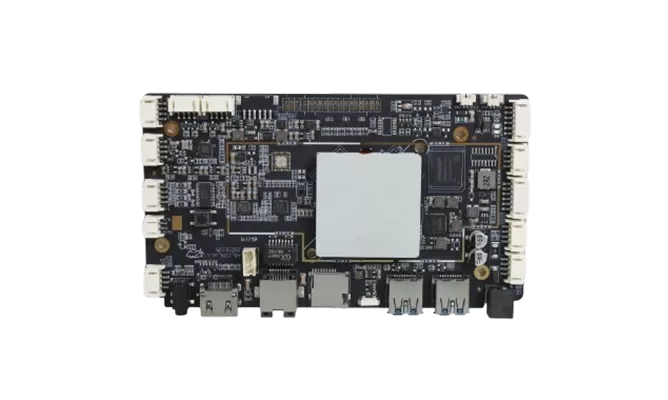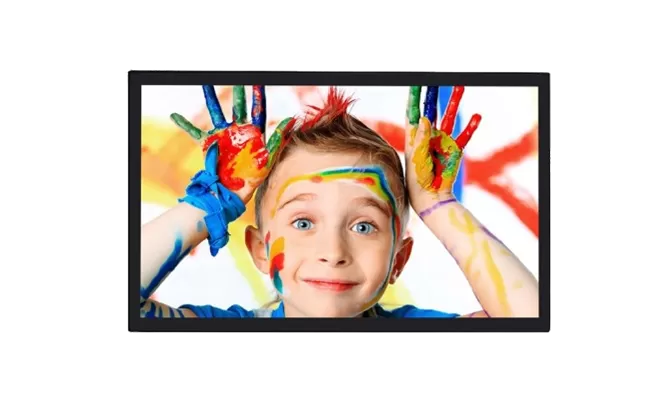
Rockchip is a leading manufacturer of System-on-Chip (SoC) solutions, specializing in ARM-based processors designed for smart devices. Established in 2001 and headquartered in Xiamen, China, the company's technology is widely implemented across digital signage, consumer electronics, industrial embedded systems, IoT gateways, and edge computing devices. In simple terms, Rockchip processors form the core of products that require dependable multimedia playback, adaptable display output, energy-efficient performance, and compatibility with operating systems like Android and Linux. These strengths make Rockchip a preferred choice for developers building commercial or embedded systems alike.
One of Rockchip's greatest strengths lies in its balance of performance, cost efficiency, and ecosystem maturity. Its multimedia capabilities ensure smooth decoding and playback of high-resolution video, commonly supporting 4K and even extending up to 8K on select platforms. The company's processors integrate seamlessly with Android and Linux environments, enabling faster development cycles and broader software compatibility—factors that shorten time-to-market for new products. Their efficient power-to-performance ratio also makes them suitable for 24/7 commercial use, particularly in fanless designs that prioritize silent, durable operation. Additionally, Rockchip systems feature rich input/output options and flexible integration, simplifying customization for OEMs and ODMs that build devices with diverse screen configurations or peripheral requirements. Finally, the chips' edge-friendly computing capabilities allow for localized data processing with low latency, reducing dependence on cloud infrastructure while improving operational responsiveness.
Rockchip processors have a versatile range of uses across multiple industries. In digital signage, they drive media players capable of 4K and 8K playback, supporting advertising displays, menu boards, and other visual communication systems. These chips are equally essential for building interactive kiosks and smart displays used in retail, corporate, and transportation environments. In the consumer electronics space, Rockchip powers popular devices such as Android TV boxes, tablets, and smart televisions—products that require reliable performance and strong graphic rendering.
Beyond consumer applications, Rockchip plays a key role in industrial equipment, powering devices like human-machine interface (HMI) panels, automation controllers, and industrial PCs. The processors also underpin IoT gateways and edge computing devices that handle data aggregation, device management, and protocol conversion locally. Furthermore, Rockchip's ability to perform lightweight AI inference makes it a valuable component in emerging AI-driven signage and smart retail systems that depend on real-time data analysis and reaction.
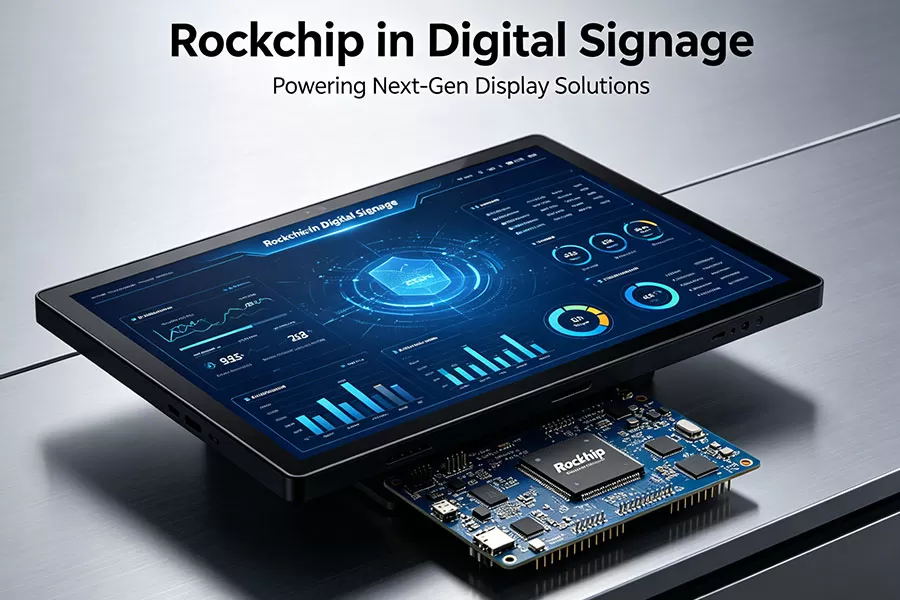
Digital signage represents one of the most widespread applications of Rockchip technology. Businesses rely on their processors to deliver stable performance, remote content management, and continuous operation across varied environments, including retail stores, transportation hubs, restaurants, and corporate spaces. Rockchip enables seamless playback of diverse content types such as video, images, and web-based media while supporting advanced layout options like split screens and multi-zone configurations. The processors also ensure reliable operation even during network interruptions, thanks to local content caching, and allow for easy integration with common content management systems to streamline remote monitoring and updates.
A notable example is SUNCHIP's line of 4K and 8K media players, which use Rockchip processors to provide commercial-grade performance. These systems are built for stability, scalability, and high customization, making them ideal for OEMs and ODMs serving the digital signage market.
In the consumer sector, Rockchip processors are prominent in devices that prioritize multimedia quality and smooth user interaction. They power Android TV boxes, streaming devices, tablets, and smart TVs, offering the performance and compatibility necessary for superior viewing and browsing experiences. Advanced chipsets such as the RK3588 are particularly well-suited for these devices due to their high graphics performance, support for high-resolution displays, and versatile connectivity options. Rockchip's strong compatibility with both Android and Linux provides engineers with the flexibility to adapt products for various market segments.
SUNCHIP's interactive all-in-one systems exemplify this integration. By leveraging Rockchip's processing technology, these devices deliver fast, responsive touch performance and vivid visual output. They can also be configured to meet international certification standards such as CE or FCC, ensuring reliable and compliant operation across global markets.
Rockchip has established a strong presence in industrial applications, where operational stability, long production life, and system adaptability are crucial. Its processors are frequently integrated into touch-based human-machine interfaces, embedded controllers, industrial PCs, vending machines, and data collection terminals. With efficient power management and low heat output, Rockchip-based systems support fanless or low-noise designs suitable for continuous 24/7 operation. The broad compatibility with peripheral devices—from barcode scanners and printers to various communication interfaces—makes Rockchip an excellent fit for industrial environments that demand both reliability and flexibility.
In IoT and edge computing, Rockchip processors enable decentralized data processing and intelligent device communication. By managing tasks such as protocol conversion, local data aggregation, and device synchronization, they allow IoT gateways to efficiently connect a network of sensors and machines. At the edge computing level, Rockchip supports real-time data filtering and analytics, reducing latency and minimizing the burden on cloud services. This makes it especially useful for applications involving remote device management, firmware updates, and system monitoring.
In sectors like healthcare and public administration, Rockchip's technology powers embedded terminals used for information displays, queue management, and local communication systems. These setups maintain high availability and real-time responsiveness even when connectivity is limited, providing dependable performance in mission-critical scenarios.
Instead of focusing only on benchmarks, most product teams compare chips by deployment risk and total cost.
Decision factor | Where Rockchip often performs well | What you should confirm |
Multimedia & display | Strong video decode + display output | Do you need 4K/8K, multi-display, or multi-stream? |
OS ecosystem | Android/Linux maturity | AOSP customization? Linux BSP needs? |
Cost & scalability | Competitive BOM and broad adoption | Long-term supply and consistent SKUs? |
Commercial/industrial reliability | Suitable for long-running terminals | Wide-temp, EMC needs, certification scope? |
Edge/AI readiness | Works for many edge use cases (model-dependent) | Do you need NPU support and which frameworks? |
Looking ahead, Rockchip is poised to play an increasingly vital role in the evolution of connected and intelligent devices. Future trends highlight the integration of AI-driven signage that can adapt content dynamically based on audience awareness or real-time conditions. In the retail space, Rockchip processors are laying the groundwork for smarter store environments featuring unified content management systems, networked digital displays, and embedded analytics for improved customer experience. The rise of 5G and edge computing further enhances real-time communication and remote operations by reducing latency and decentralizing processing tasks.
As demand for customized solutions continues to grow, OEMs and ODMs are turning to Rockchip platforms for tailored system designs, supporting custom enclosure formats, specialized I/O configurations, optimized OS builds, and fleet management tools. Companies such as SUNCHIP are responding to these advances by providing Rockchip-based development and manufacturing services that help brands deliver optimized embedded and signage products to market with greater speed and flexibility.
Rockchip is used in digital signage, smart displays, Android TV boxes, tablets, industrial embedded systems, IoT gateways, and edge computing devices—especially where multimedia playback and Android/Linux support are important.
Yes. Rockchip platforms are commonly used in signage media players because they support stable high-resolution playback, flexible display output, and commercial 24/7 operation.
Many Rockchip SoCs support Android and/or Linux (depending on the chipset and BSP), which is why they are popular for embedded and commercial devices.
Start with requirements: target resolution (4K/8K), number of displays, interfaces, thermal design, OS (Android/Linux), AI needs, certification, and supply lifecycle—then match to the appropriate Rockchip platform.
Rockchip processors power a wide range of modern devices—from digital signage and interactive kiosks to consumer electronics, industrial automation, and IoT edge computing. Their popularity comes from a practical combination of multimedia performance, ecosystem maturity, power efficiency, and cost effectiveness.
If you need customized Rockchip-based solutions (digital signage players, embedded boards, interactive displays), SUNCHIP Technology Co., Ltd. can provide OEM/ODM services and help evaluate the right platform for your application.

 EN
EN